Snap Planets List: All Snapchat Planets in Order and What They Mean
Introduction
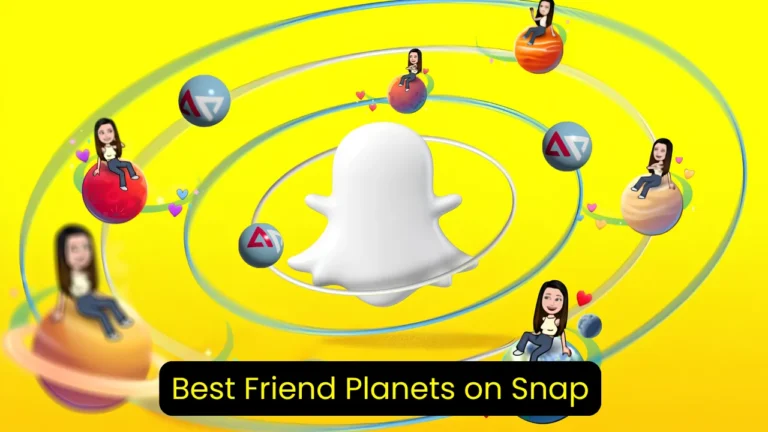
If you have Snapchat+ and have noticed a small planet beside a friend’s profile, you may be wondering what it actually means. The Snap planets list is part of Snapchat’s Friend Solar System, a Snapchat+ feature that represents the eight people in someone’s Best Friends list as planets.
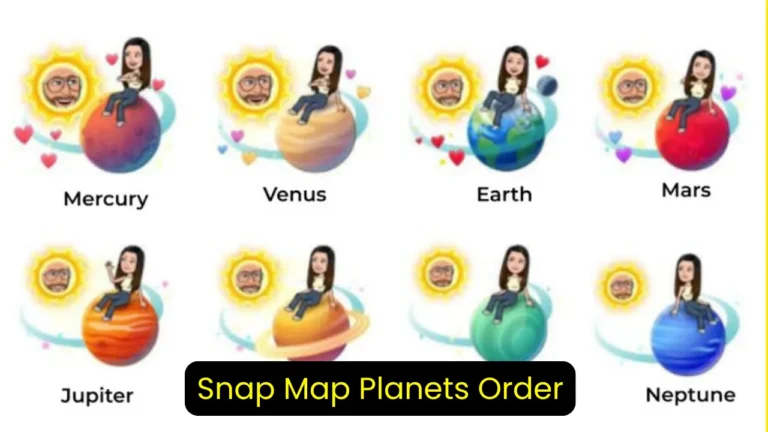
The order is simple: Mercury, Venus, Earth, Mars, Jupiter, Saturn, Uranus, and Neptune. Mercury represents the #1 position, while Neptune represents the #8 position. Snapchat officially confirms that each planet represents a different position among the eight friends you Snap and Chat with the most.
Snap Planets List in Order
Here is the complete Snapchat planets list at a glance:
| Rank | Snapchat Planet | What It Means |
| 1 | Mercury | Your #1 Best Friend |
| 2 | Venus | Your #2 Best Friend |
| 3 | Earth | Your #3 Best Friend |
| 4 | Mars | Your #4 Best Friend |
| 5 | Jupiter | Your #5 Best Friend |
| 6 | Saturn | Your #6 Best Friend |
| 7 | Uranus | Your #7 Best Friend |
| 8 | Neptune | Your #8 Best Friend |
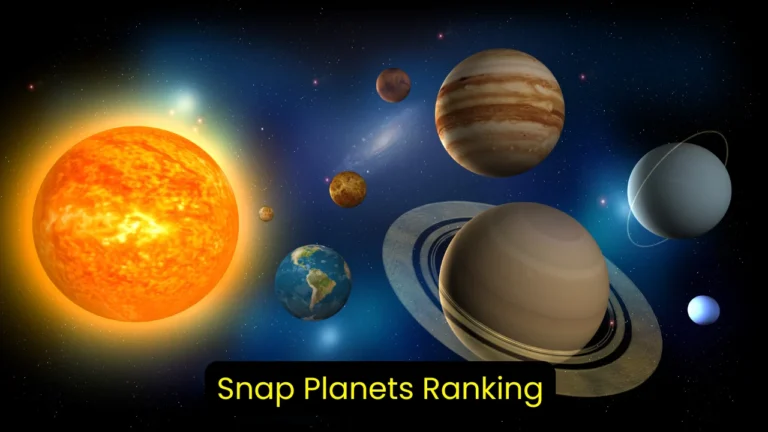
The sequence follows the familiar order of the eight planets in our solar system. On Snapchat, however, the planets are being used as a visual ranking system rather than as an astronomy feature. Snapchat says its Friend Solar System assigns each planet to a different position in a person’s Best Friends list.
What Are Snapchat Planets?
Snapchat planets are visual indicators used by Snapchat+’s Friend Solar System feature. They show where you rank among another person’s eight Best Friends.
Think of the feature this way:
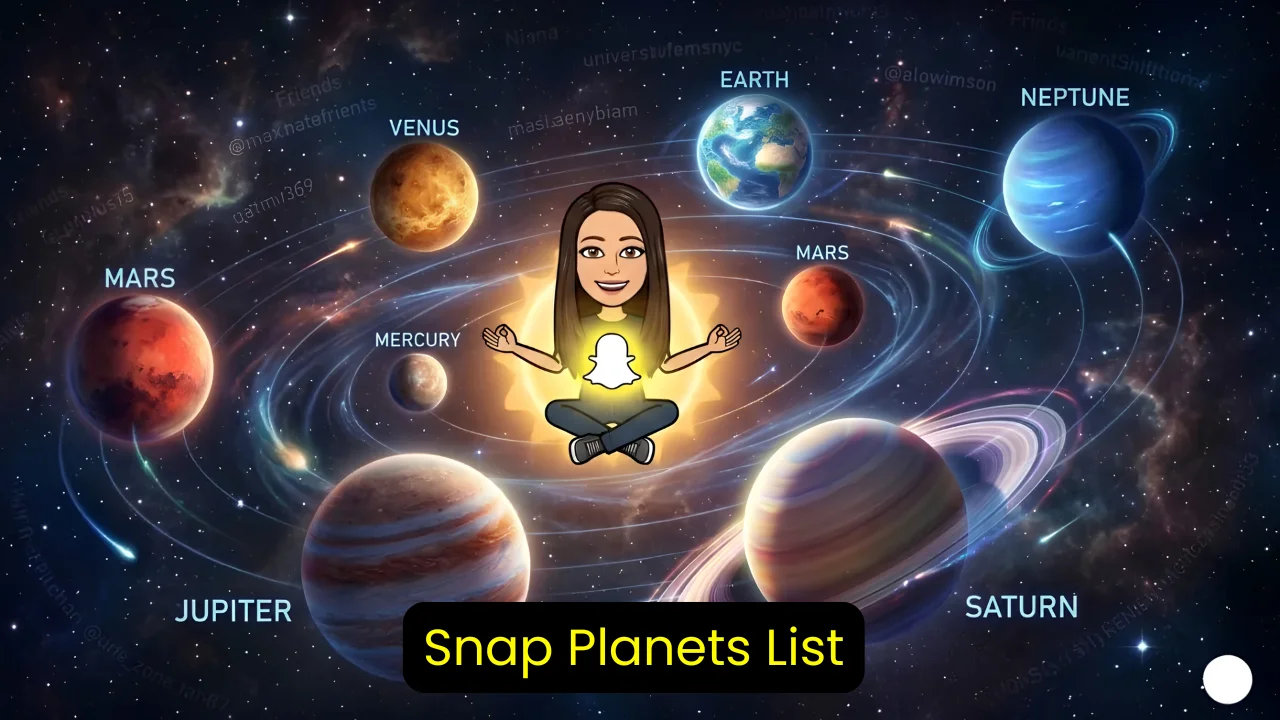
- The Snapchat user is the Sun.
- Their eight Best Friends are represented by the eight planets.
- Mercury is position #1.
- Venus is position #2.
- Earth is position #3.
- Mars is position #4.
- Jupiter is position #5.
- Saturn is position #6.
- Uranus is position #7.
- Neptune is position #8.
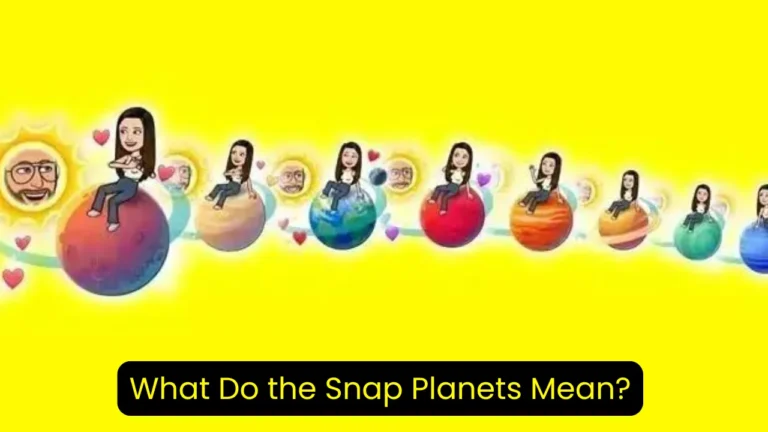
The closer the planet is to the Sun in the Friend Solar System, the higher the person’s position in that user’s Best Friends ranking.
This is why seeing Mercury is generally more significant than seeing Neptune. Mercury means the person occupies the first position, while Neptune represents the eighth position.
Also Read: Snap BSF List Planets Order
Snapchat Planets in Order and Meaning
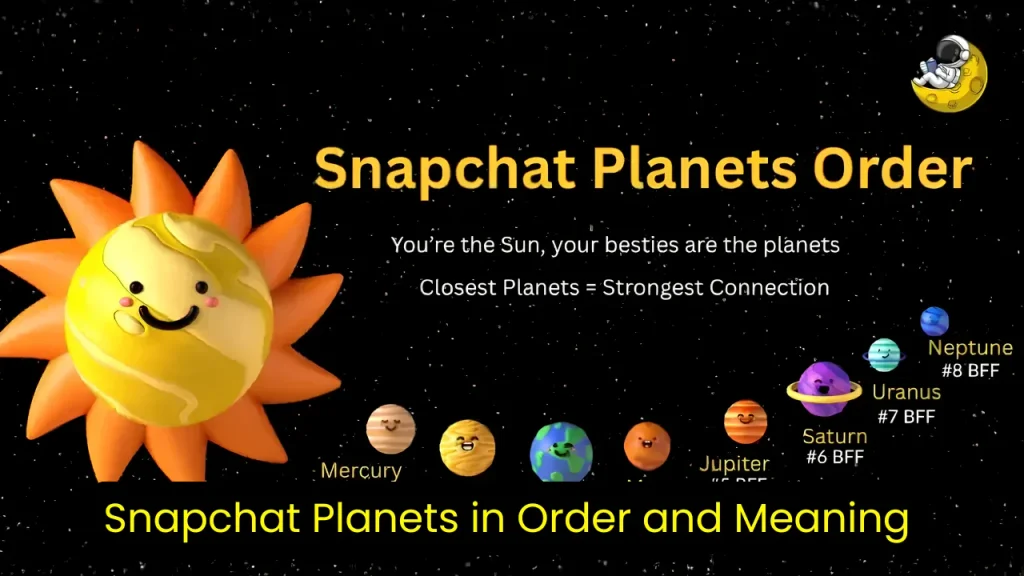
1. Mercury: #1 Best Friend
Mercury is the first planet in the Snap planets list.
If you appear as Mercury in someone’s Friend Solar System, you occupy the #1 position in their Best Friends list.
Snapchat’s Best Friends are the people you Snap and Chat with most frequently, and Snapchat can have up to eight Best Friends.
So, in simple terms:
Mercury = their closest-ranked Snapchat friend.
The Mercury Friendmoji is also visually distinctive, which makes it relatively easy to recognize when you see it in the Friend Solar System.
2. Venus: #2 Best Friend
Venus represents the second position.
If someone sees you as Venus in their Snapchat Friend Solar System, you are their #2 Best Friend according to the ranking represented by the feature.
You are still inside their top two, but another person currently occupies the Mercury position.
Venus = #2 in their Best Friends ranking.
3. Earth: #3 Best Friend
Earth represents position #3.
If your Friendmoji appears as Earth, you are the third-ranked person in that friend’s Friend Solar System.
The Earth Friendmoji is easy to distinguish because it uses a globe-like appearance, making it one of the more recognizable Snapchat planet icons.
Earth = #3 Best Friend.
Also Read: Snap Emojis Planets
4. Mars: #4 Best Friend
Mars represents the fourth position.
A Mars ranking means you currently occupy the #4 position in that person’s Snapchat Best Friends list.
It is important not to interpret this as a fixed friendship level. Snapchat says Best Friends are updated regularly, so rankings can change as your interactions with different people change.
Mars = #4 Best Friend.
5. Jupiter: #5 Best Friend
Jupiter represents position #5.
If someone sees you as Jupiter, you are currently fifth among the eight people represented in their Friend Solar System.
The Jupiter Friendmoji has a larger, striped appearance inspired by the real Jupiter.
Jupiter = #5 Best Friend.
6. Saturn: #6 Best Friend
Saturn represents the sixth position.
This is one of the easiest planets to identify because of its prominent ring system.
If your Friendmoji is Saturn, you occupy the #6 position in that person’s Friend Solar System.
Saturn = #6 Best Friend.
7. Uranus: #7 Best Friend
Uranus represents position #7.
You are still among the eight friends represented in that person’s Friend Solar System, but you rank seventh.
Uranus = #7 Best Friend.
8. Neptune: #8 Best Friend
Neptune is the eighth and final planet in the Snap planets list.
If someone sees you as Neptune, you occupy the #8 position in their Friend Solar System.
You have made the person’s top eight, but seven people currently rank ahead of you.
Neptune = #8 Best Friend.
Also Read: Snap BFF Planets
Snap Planets Numbered 1 to 8
If you searched specifically for Snap planets numbered, this is the quickest reference:
- Mercury = #1
- Venus = #2
- Earth = #3
- Mars = #4
- Jupiter = #5
- Saturn = #6
- Uranus = #7
- Neptune = #8
There are no additional planets after Neptune in Snapchat’s Friend Solar System. Snapchat’s official guide lists these eight planets as the Friendmoji representations used by the feature.
How Does the Snapchat Friend Solar System Work?
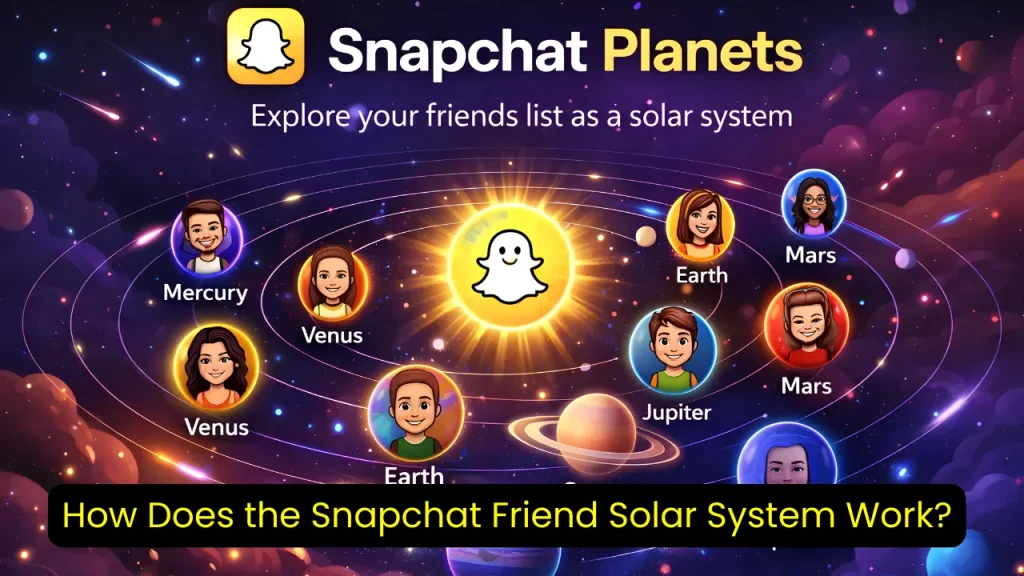
The Friend Solar System is a Snapchat+ feature designed around Snapchat’s Best Friends system.
Snapchat says Best Friends are the people you Snap and Chat with the most, and there can be up to eight of them. These Best Friends are updated regularly.
The Friend Solar System turns that ranking into a visual model:
You → Sun
Your #1 friend → Mercury
Your #2 friend → Venus
Your #3 friend → Earth
Your #4 friend → Mars
Your #5 friend → Jupiter
Your #6 friend → Saturn
Your #7 friend → Uranus
Your #8 friend → Neptune
This makes it easier to understand your position without displaying a conventional numbered list.
Why Does Snapchat Use Planets?
The planet system is essentially a visual metaphor.
In a real solar system, Mercury is closer to the Sun than Venus, Earth is farther away than Venus, and so on. Snapchat borrows that familiar sequence and uses it to represent positions in a Best Friends ranking.
The result is an easy-to-recognize system where closer to the Sun means a higher position.
Also Read: Snap Plus Planets
Does Mercury Mean Someone Is Your Best Friend?
Yes, in the context of the Friend Solar System, Mercury represents the #1 position in the other person’s Best Friends ranking.
But there is an important distinction.
Being someone’s Mercury does not automatically mean that they are also your Mercury.
For example:
| Your position in their system | Their position in your system |
| You are Mercury | They could be Venus |
| You are Venus | They could be Mercury |
| You are Earth | They could be Jupiter |
| You are Neptune | They could be Mars |
The two rankings do not have to match.
That is because each person’s Best Friends list is based on their own Snapchat interaction patterns. Snapchat describes Best Friends as the people each user Snaps and Chats with the most.
Can Your Snapchat Planet Change?
Yes.
Your Snapchat planet is not necessarily permanent because Best Friends can change over time.
Snapchat states that Best Friends are updated regularly.
For example, imagine that you are currently someone’s Jupiter:
Monday: Jupiter, #5
You start exchanging significantly more Snaps and Chats with that person during the week.
Later: Venus, #2
That change does not necessarily mean anything dramatic happened in the friendship. It can simply reflect a change in interaction patterns.
This is one reason you should treat Snapchat planet rankings as a snapshot of Snapchat activity rather than a permanent measurement of a friendship.
Does a Snapchat Planet Measure Your Real-Life Friendship?
Not necessarily.
This is one of the most important points to understand about the Snap planets list.
A planet represents your position in a Snapchat Best Friends ranking, not a formal measurement of how close you are to someone in real life.
For example, someone could be your closest friend offline but appear lower in your Friend Solar System if you communicate with other people more frequently on Snapchat.
Likewise, someone you interact with heavily on Snapchat could rank highly even if you do not consider them your closest friend outside the app.
So:
Snapchat planet ranking ≠ real-life friendship ranking.
It is better understood as an indicator of interaction on Snapchat.
Also Read: Snap Planets BSF List
How to See Your Snapchat Planet?
If you have access to Snapchat+’s Friend Solar System, you can check your position through a friend’s Friendship Profile.
The general process is:
- Open Snapchat.
- Go to the friend whose Friendship Profile you want to check.
- Look for the Best Friends badge with the gold ring.
- Tap the badge.
- Snapchat will show your planet in that person’s Friend Solar System.
Snapchat’s official documentation says Snapchat+ subscribers can tap the Best Friends badge to see which planet they occupy in another person’s Solar System.
Why Can’t I See Snapchat Planets?
There are several possible reasons.
You Do Not Have Snapchat+
Friend Solar System is a Snapchat+ feature, so the feature is not part of the standard Snapchat experience for everyone.
Friend Solar System Is Turned Off
Snapchat says the Solar System feature is off by default for first-time Snapchat+ subscribers. It can be turned on from Snapchat+’s feature management page and can also be turned off later.
You Are Not in the Person’s Top Eight
There are only eight planet positions.
If you are outside someone’s eight Best Friends, you will not occupy one of the eight planets in their Friend Solar System.
The Ranking Has Changed
Best Friends are updated regularly. If your interaction pattern changes, your position can change as well.
Snapchat Planets vs. Best Friend Emojis
These features are related to Snapchat friendships, but they are not the same thing.
| Feature | Snapchat Planets | Best Friend Emojis |
| Main feature | Friend Solar System | Snapchat friendship indicators |
| Available through | Snapchat+ feature | Snapchat |
| Main purpose | Shows your position in someone’s top eight | Indicates different friendship/interactions |
| Ranking | #1 to #8 | Depends on the specific emoji |
| Visual system | Mercury to Neptune | Emoji symbols |
| Can change? | Yes | Yes |
Snapchat officially states that Best Friends receive special Friend Emojis next to their names and that there can be up to eight Best Friends.
Also Read: What the Planets Mean on Snap?
Are Snapchat Planets Mutual?
No, not necessarily.
This is a common source of confusion.
Suppose you are Mercury in your friend’s Friend Solar System. That means you are #1 in their system.
It does not automatically mean they are Mercury in yours.
Their ranking and your ranking are separate.
Example
Imagine two users, Alex and Sam.
Alex interacts with Sam more than anyone else, so:
Sam = Mercury in Alex’s Solar System
But Sam may interact more with Taylor than Alex, so:
Alex = Mars in Sam’s Solar System
Both positions can be correct at the same time.
The key is to remember whose Solar System you are looking at.
Do Snapchat Planets Show Who You Message the Most?
They are connected to the Best Friends system, which Snapchat defines around the people you Snap and Chat with the most.
However, it would be inaccurate to reduce the system to a simple formula such as “number of messages = planet.”
Snapchat does not publish a complete public scoring formula explaining exactly how every individual interaction translates into a specific planet position.
For that reason, claims such as “100 messages always equal Mercury” should not be treated as official Snapchat rules.
The safest interpretation is:
Your planet represents your position among that person’s Snapchat Best Friends.
Also Read: Best Friend Planets on Snap
Is Snapchat Planet #1 Better Than Planet #8?
If you are talking strictly about ranking, yes.
Mercury is #1 and Neptune is #8.
But “better” depends on what you mean.
Mercury indicates a higher position in that person’s Snapchat Best Friends ranking. It does not prove that the person values you more in every part of their life.
A Snapchat ranking reflects activity on the platform, not the entire relationship.
Quick Snapchat Planets Cheat Sheet
Save this list if you regularly use Snapchat+:
☀️ Sun: The Snapchat user
1. Mercury: Closest-ranked friend
2. Venus: Second-ranked friend
3. Earth: Third-ranked friend
4. Mars: Fourth-ranked friend
5. Jupiter: Fifth-ranked friend
6. Saturn: Sixth-ranked friend
7. Uranus: Seventh-ranked friend
8. Neptune: Eighth-ranked friend
The official Snapchat support page confirms the eight planet names used by Friend Solar Systems.
Common Mistakes About the Snap Planets List
Mistake 1: Thinking Neptune Means You Are Not Friends
Not true.
Neptune means you occupy the eighth position among the person’s Best Friends represented by the Friend Solar System. You are still within the top eight.
Mistake 2: Assuming the Planet Is Permanent
It is not necessarily permanent. Snapchat says Best Friends are updated regularly.
Mistake 3: Assuming Both Friends Must Have the Same Planet
They do not.
Friend Solar Systems are based on each person’s own Best Friends ranking.
Mistake 4: Treating the Planet as a Real-Life Relationship Score
The planet reflects Snapchat interaction, not the complete quality or importance of a relationship.
Mistake 5: Assuming Every Snapchat User Has the Feature
Friend Solar System is a Snapchat+ feature, and Snapchat says it is off by default for first-time subscribers.
Also Read: What Do the Different Planets Mean on Snap?
What Is the Closest Planet on Snapchat?
Mercury is the closest planet in Snapchat’s Friend Solar System.
It represents the #1 position in a person’s Best Friends list.
The sequence then continues outward:
Mercury → Venus → Earth → Mars → Jupiter → Saturn → Uranus → Neptune
This mirrors the order of the eight planets in the actual solar system.
What Is the Farthest Planet on Snapchat?
Neptune is the farthest planet in the Snapchat Friend Solar System.
It represents position #8, the final position among the eight Best Friends.
If you are Neptune, you are still inside the person’s top eight represented by the Friend Solar System.
Does Snapchat Have a Pluto Planet?
No.
Snapchat’s Friend Solar System uses eight planets: Mercury, Venus, Earth, Mars, Jupiter, Saturn, Uranus, and Neptune. Snapchat’s official support guide does not include Pluto among the Friendmoji planet representations.
This follows the modern eight-planet classification of our solar system rather than the older nine-planet model that included Pluto.
Why the Snap Planets List Is Useful?
The feature does more than add a fun visual effect to Snapchat+.
It gives users a quick way to understand where they stand in someone’s top eight Snapchat connections without needing access to another person’s complete Best Friends list.
That distinction matters because Snapchat says other people cannot see your complete Best Friends list. People may see if they are among your Best Friends, but the full list remains private.
The Friend Solar System therefore acts as a limited, visual signal rather than a public ranking table.
Also Read: What Are the Snap Planets?
FAQ
What is the Snapchat planets list?
The Snapchat planets list is the sequence used by Snapchat+’s Friend Solar System: Mercury, Venus, Earth, Mars, Jupiter, Saturn, Uranus, and Neptune. Each planet represents one of the eight positions in a person’s Best Friends ranking.
What does Mercury mean on Snapchat?
Mercury represents the #1 position in a person’s Friend Solar System. In other words, you are their highest-ranked Best Friend within the system.
What does Venus mean on Snapchat?
Venus represents the #2 position in the Friend Solar System.
What does Earth mean on Snapchat?
Earth represents the #3 position.
What does Mars mean on Snapchat?
Mars represents the #4 position.
What does Jupiter mean on Snapchat?
Jupiter represents the #5 position.
What does Saturn mean on Snapchat?
Saturn represents the #6 position.
What does Uranus mean on Snapchat?
Uranus represents the #7 position.
What does Neptune mean on Snapchat?
Neptune represents the #8 position, the final planet position in the Friend Solar System.
How many Snapchat planets are there?
There are eight Snapchat planets in the Friend Solar System: Mercury, Venus, Earth, Mars, Jupiter, Saturn, Uranus, and Neptune.
Do you need Snapchat+ to see Snapchat planets?
Yes. The Friend Solar System is a Snapchat+ feature. Snapchat’s official support documentation describes it specifically as a Snapchat+ feature.
Can your Snapchat planet change?
Yes. Best Friends are updated regularly, so your position can change as your Snapchat interaction patterns change.
Are Snapchat planets mutual?
No. Your planet in another person’s Friend Solar System does not have to match their planet in yours.
Does Mercury mean you are someone’s best friend?
In the Friend Solar System ranking, yes. Mercury represents their #1 Best Friend position.
Is Neptune a bad sign on Snapchat?
Not necessarily. Neptune simply represents #8 among the eight Best Friends shown by the Friend Solar System. It does not measure the overall quality of your real-life friendship.
Why can’t I see the Friend Solar System?
You may not have Snapchat+, the feature may be disabled, or you may not be included among that person’s eight Best Friends. Snapchat also states that the Solar System is off by default for first-time Snapchat+ subscribers until they enable it.
Also Read: Snap Planets in Order
Conclusion
The Snap planets list is straightforward once you know the ranking: Mercury is #1, followed by Venus, Earth, Mars, Jupiter, Saturn, Uranus, and Neptune at #8. The Friend Solar System is a Snapchat+ feature that turns your Best Friends ranking into a visual solar system. Just remember that the ranking reflects Snapchat interaction, not the full value of a real-world friendship.

Emily Carter is a writer who enjoys covering the entertainment world, from celebrities and movies to television and pop culture. She focuses on making stories interesting, relatable, and easy to follow.